 |
| Product life-cycle |
IT is where What's Possible goes to die.
 For user-centric software developers, having the human activity of making software under the yoke of an IT department is like a fish in outer space.
Wrong environment. Wrong vibe.What should be the goals and purposes of product development are frequently at odds with the raison d'etre of IT. By popular definition, IT deals with all things electronic.
Information Technology - Often the name of the part of an enterprise that deals with all things electronic. Free On-Line Dictionary of ComputingAll things electronic is hardly a human activity. Successful software involves people. The most successful software focuses on human pains and gains.
People unfamiliar with the nuts & bolts of software development imagine it's an engineering process, but it's a profoundly human activity.The product-focused team is rooted in the common cause of serving people by relieving pains or offering gains. In Product vs. IT Mindset, Marty Cagan chose the words Mercenaries and Missionaries to distinguish the IT Mindset from the Product Mindset.
― Alan Cooper
In an IT mindset organization, product and tech are mercenaries. There is little to no product passion. They are there to build whatever. In a product organization, product and tech are missionaries. They have joined the organization because they care about the mission and helping customers solve real problems.
― Marty Cagan

IT programmers tend to make marginally consequential changes to existing applications. The applications built and supported by IT serve people in other departments ― users that frequently harbor contempt for IT. IT programmers derisively refer to these users as The Business.
Because there is a death of product passion in IT, programmers tend to gold plate dubious features behind the guise of some perceived benefit to The Business. If The Business doesn't use the feature, no one loses their job or their life-savings.
Contrast the IT mindset to a product-centric developer's mindset in a startup. Product-centric developers know the existential narrative is:
Deliver value or die.For software startups, continuous innovation and connecting with customers are dual imperatives. On the other hand, IT departments focus on support and execution over innovation.
"A business that isn’t investing in tomorrow, is a business that’s already in the process of dying.”IT departments are better equipped to handle knowns than unknowns. IT is ladened with processes, governance, and gratuitous ceremony.
― Reid Hoffman
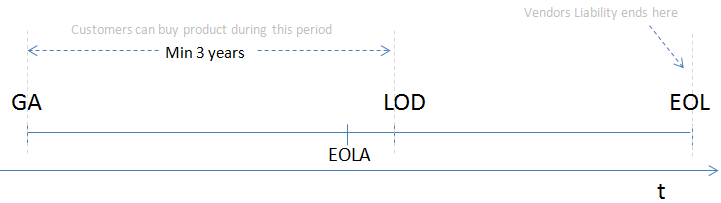
"Every time another execution process is added, corporate innovation dies a little more.”The product mindset is that the product is paramount so all but the most pragmatic of processes falls by the wayside. Products have an inception and an end of life. IT tends to fund ongoing projects, rather than products with a beginning, middle, and end.
― Steve Blank
Delivery teams deliver software products - not projects - that run from inception to retirement.Product-minded behemoths like Apple, Amazon, and Google demonstrate that people-pleasing products are not limited to startups.
― Jez Humble
To raise my killer product, I'm determined to partner with people steeped in a product mindset, then rally them around our product to change the world.My philosophy is that everything starts with a great product. So, you know, I obviously believed in listening to customers, but customers can't tell you about the next breakthrough that's going to happen next year that's going to change the whole industry. So you have to listen very carefully. But then you have to go and sort of stow away -- you have to go hide away with people that really understand the technology, but also really care about the customers, and dream up this next breakthrough. And that's my perspective, that everything starts with a great product.
― Steve Jobs
REFERENCES
- DevOps and the "Product-Centric" Approach, DevOpsGuys, 13 December 2013.
- Nuke & Pave Information Technology, by Bob MacNeal, 23 March 2009.
- Product vs. IT Mindset, by Marty Cagan, Silicon Valley Product Group, 14 October 14 2014.